
The Reserve Bank of India's (RBI's) interest rate decision, West Asia conflict and trading activity of foreign investors are the key factors that will dictate investors' sentiment in the market this week, analysts said. Moreover, quarterly earnings from IT bellwether TCS, domestic macroeconomic data and movement in global oil benchmark Brent crude would also guide trends in the market. Worsening tensions in the Middle East and foreign fund outflows were the major culprits behind the equity markets sharp fall last week.

Three years after India declared its goal to become a net-zero economy by 2070, the policy design for achieving the target has begun, with the NITI Aayog forming dedicated multi-sectoral committees to prepare a transition plan. In 2021, India joined a select group of nations that set a target year for becoming net-zero carbon economy. At COP26 in Glasgow, Prime Minister Narendra Modi outlined a five-pronged 'Panchamitra' climate action target for India and committed to a net-zero target by 2070, joining nations like the US, the UK, and China.

'A possible post-election growth momentum may be lost.'

The Reserve Bank of India on Monday gave strong hints of another hike in its key interest rates at the policy review on Tuesday, saying that high inflation requires further monetary tightening, slowdown in growth notwithstanding.
In its macroeconomic review report, the RBI has cut FY13 GDP growth forecast to 5.7% vs 6.5%.

This time the all-powerful interest-rate setting panel, whose constitution was notified by the government on Thursday, will take call on interest rate. But that's not the only change. The Reserve Bank of India has also decided to change the timing of announcement of its policy review, due next Tuesday, to mid-afternoon.

By taking the mutual fund route, investors can take exposure to gilts with small amounts. Over a decade or more, returns from these funds tend to be sound.
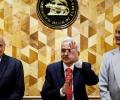
'The central bank has highlighted that the slowdown in growth has been limited to a few sectors and overall growth is expected to pick up in the second half of the year.'

Crypto assets should not be granted official currency or legal tender status, the much-awaited synthesis paper by the International Monetary Fund (IMF) and Financial Stability Board (FSB) has said ahead of the G20 leadership summit under India's presidency. However, the report has argued against a blanket ban on activities linked to crypto assets, explaining that such a move can be costly as well as technically demanding to enforce. Central banks should avoid holding crypto assets in their official reserve as they pose a risk to monetary and global financial stability, according to the synthesis paper.
In an indication of further tightening of monetary policy, the Reserve Bank of India's (RBI) pre-policy report today said that managing inflation and inflationary expectations will be the dominant theme of monetary policy management in 2010-11.

RBI says food supply constraints to taper off only over time.

The size of Reserve Bank's balance sheet increased by 11.08 per cent to Rs 70.47 lakh crore as on March 2024, leading to the highest-ever dividend payout to the government, according to the central bank's annual report. In actual terms, the increase was Rs 7,02,946.97 crore over Rs 63.45 lakh crore as on March 2023.
Individuals and corporate borrowers face the prospect of further interest rate increases, as the Reserve Bank of India battles inflation and high credit growth.
This Statement consists of two parts: Part I. Annual Statement on Monetary Policy for the Year 2007-08; and Part II. Annual Statement on Developmental and Regulatory Policies for the Year 2007-08.

In the Macroeconomic & Monetary Developments report released this evening, the central bank drew comfort from the forecasters' survey -- which estimated that the Indian economy would grow by 6.9 per cent this year -- and improved business sentiments.
Professional forecasters have added to Reserve Bank of India Governor Duvvurri Subbarao's dilemma on timing the exit from an accommodative monetary policy stance.
Risk aversion leading to 'lazy banking'; lenders prefer govt securities
Reserve Bank of India Governor, Y V Reddy presented the Monetary and Credit Policy for 2006-07 on Tuesday.

The recently released RBI First Quarter Review of Monetary Policy 2009-10 and the accompanying 'Macroeconomic and Monetary Developments First quarter review 2009-10 have indicated that on the basis of Balance of Payments (BoP) the export growth for 08-09 has declined by over 22% to 5.4% and also the import growth has declined by over 21% during the same period.
Making a case for increasing prices of petroleum products and deregulating diesel prices, the Reserve Bank on Monday said these steps are necessary to contain fiscal slippages and arrest decline in growth.
India would remain among the fastest growing economies of the world in the medium-term as the country has posted a real GDP growth at 6.9 per cent in 2004-05, according to Reserve Bank of India.

According to the Reserve Bank of India's second quarter Macroeconomic and Monetary Developments review, key deficit indicators widened during the April-August period of 2011-12, compared to the corresponding period of the previous year.
Despite a higher CAD in the first quarter, capital inflows were broadly adequate to finance the current account gap, requiring only a marginal drawdown of foreign exchange reserves.
"Since pass-through of higher international oil prices to domestic prices remains incomplete, inflation remains suppressed," Reserve Bank said in its Macroeconomic and Monetary Development Review released in Mumbai.

The Reserve Bank hinted at a marginal hike in key policy rates when it reviews its monetary stance tomorrow, saying inflation was still above the comfort zone and that there was uptick in credit to non-food sectors.
Macroeconomic and Monetary Developments: First Quarter Review 2007-08.

'More than investors, fund houses, and advisors have raised caution and limited flows on small-and mid-caps.'
The Reserve Bank of India on Monday said the steps initiated by the government in recent weeks are expected to help control inflation and inflationary expectations. Listing out the possible pressure points, including high oil prices that are expected to stay at elevated levels, the RBI report on Macroeconomic and Monetary Developments in 2007-08 noted that inflation risks due to petroleum prices remained incipient.

India's foreign exchange reserves increased to $604 billion as on December 1, surpassing the $600 billion mark after a gap of about four months. The forex reserves were last above the $600 billion mark on August 11 this year. "India's foreign exchange reserves stood at $604 billion as on December 1, 2023.

Improved monsoon, solid fiscal performance, and capex push by the public and private sectors augurs well for India's macroeconomic stability and growth, the finance ministry's monthly economic review for June 2023 said. But the report said that while India's domestic fundamentals remain strong, negative cross-border spillovers and adverse global developments could act as a deterrent in achieving the high growth path this financial year. "An improved matching of aggregate supply and aggregate demand in the Indian economy underpins the progress made in the control of domestic inflation and the consequent strengthening of macroeconomic stability," the review said.
The manufacturing sector's robust performance was largely contributed by machinery and equipment, food products, basic metal and alloy industries and chemicals and chemical products, the RBI said.
According to the Third Advance Estimates for 2007-08, the total foodgrains production is slated to reach an all-time high at 227.3 million tonnes, recording an increase of 4.6 per cent over the previous year (217.3 million tonnes). The production during 2007-08 would exceed the target set earlier (221.5 million tonnes) by 5.8 million tonnes. Notwithstanding the moderation, the growth performance was in tune with the high average real GDP growth of 8.7 per cent.
Banks are shying away from the unsecured lending market, thanks to the rising instances of defaults and recovery woes.The rate of growth in the personal loan portfolio of banks has dipped to 13.2 per cent to Rs 58,669 crore (Rs 586.69 billion) as on February 15, 2008, compared with 30.6 per cent in the same period last year, said the Reserve Bank of India in its 2007-08 report on Macroeconomic and Monetary Developments.
The country's foreign exchange reserves stood at $309.7 billion as at end-March 2008, up $110.5 billion over end-March 2007, making it the third largest stock of reserves among emerging market economies.

Prime Minister Narendra Modi on Saturday announced the adoption of the New Delhi Leaders Declaration, a significant victory for India's G20 presidency that came amid increasing tensions and divergent views over the Ukraine conflict.

Interim Budget, the US Federal policy decision and quarterly earnings will be the major drivers for stock markets which may also see some consolidation this week, say analysts. Besides, investors would also focus on the trading activity of foreign investors and global trends for further cues. From the macroeconomic front, the PMI (Purchasing Managers' Index) data for the manufacturing sector is scheduled to be announced on Thursday.

Global trends and trading activity of foreign investors would largely dictate terms in the equity markets this week amid a lack of major domestic triggers, analysts said. Markets may face near-term consolidation due to elevated valuations, they noted. "While the previous week was predominantly shaped by developments in the US Federal Reserve policy, attention will now shift to the Bank of Japan's policy decision on December 19," Santosh Meena, Head of Research, Swastika Investmart Ltd, said.

The World Bank has appointed Indermit Gill, an Indian national, chief economist and senior vice-president for development economics at the multilateral development bank. "Indermit Gill brings to this role a combination of leadership, invaluable expertise and practical experience working with country governments on macroeconomic imbalances, growth, poverty, institutions, conflict, and climate change," World Bank President David Malpass said in a statement. His appointment will be effective September 1, 2022.

What stood out in his 15-year journey as a member of the political executive at the Centre was his glowing record as India's most successful and effective finance minister. Both as prime minister and finance minister, he understood the importance of gradualism, except when the economy or the polity was in a crisis.

Nearly 40 per cent of IITians sitting for placements in 2024 are yet to receive job offers, showing a doubling of the 'unplaced' in the last three years from 19 per cent in 2021-2022 to 38 per cent in 2023-2024.
